

Key takeaways
- Make your phone number and contact options easy to find on mobile.
- Create relevant service pages so customers can find the right information for their garage door problem.
- Build trust with customer reviews and completed-job photos, and make it easy to request a quote with a short form.
- Track qualified leads and booked jobs to understand which website pages and marketing channels bring in customers.
Your website might get plenty of visitors, but that doesn't mean you're getting more garage door leads.
This guide covers seven simple fixes to help you get more calls, quote requests and jobs from your existing website traffic.
1. Make your phone number easy to find
Place your phone number near the top of the page and make it clickable on mobile so homeowners can call you with one tap.
You can also add a fixed call button at the bottom of the mobile screen. Test it on different phones to make sure it doesn't cover important content or get in the way of browsing.
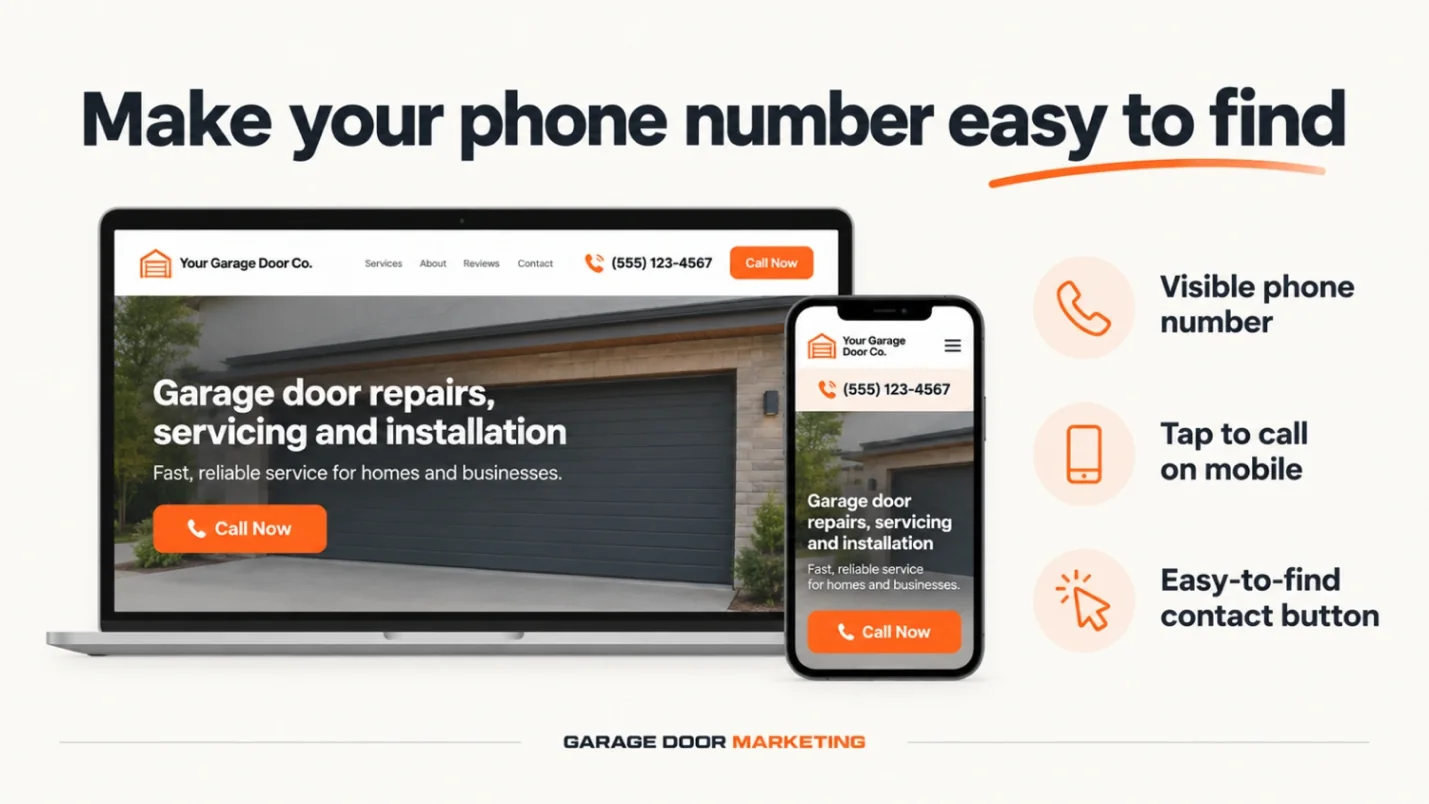
Now, look at the top section of your homepage. Does it tell visitors what you do, which problems you fix, and how they can reach you? If not, update your headline and add a short description of your services.
For example, instead of using a vague headline like “Well-Made Garage Doors,” try to use something more specific:
Garage Door Repair in [Your City], [State]
Follow it with a short sentence about your services and a visible Call Now or Request a Quote button. Make sure the headline reflects the services you offer.
These changes make it easier for homeowners to find your services and contact you. They also help your garage door marketing efforts deliver more value by giving website visitors a path to becoming customers.
2. Create a separate page for each garage door service
A single services page can't cover every customer's needs. Someone with a broken spring needs different information from someone looking to install a new garage door.
Create separate pages for your main services, such as:
- Garage door repair
- Broken spring replacement
- Garage door opener repair
- Cable repair
- Garage door maintenance
- Garage door installation and replacement
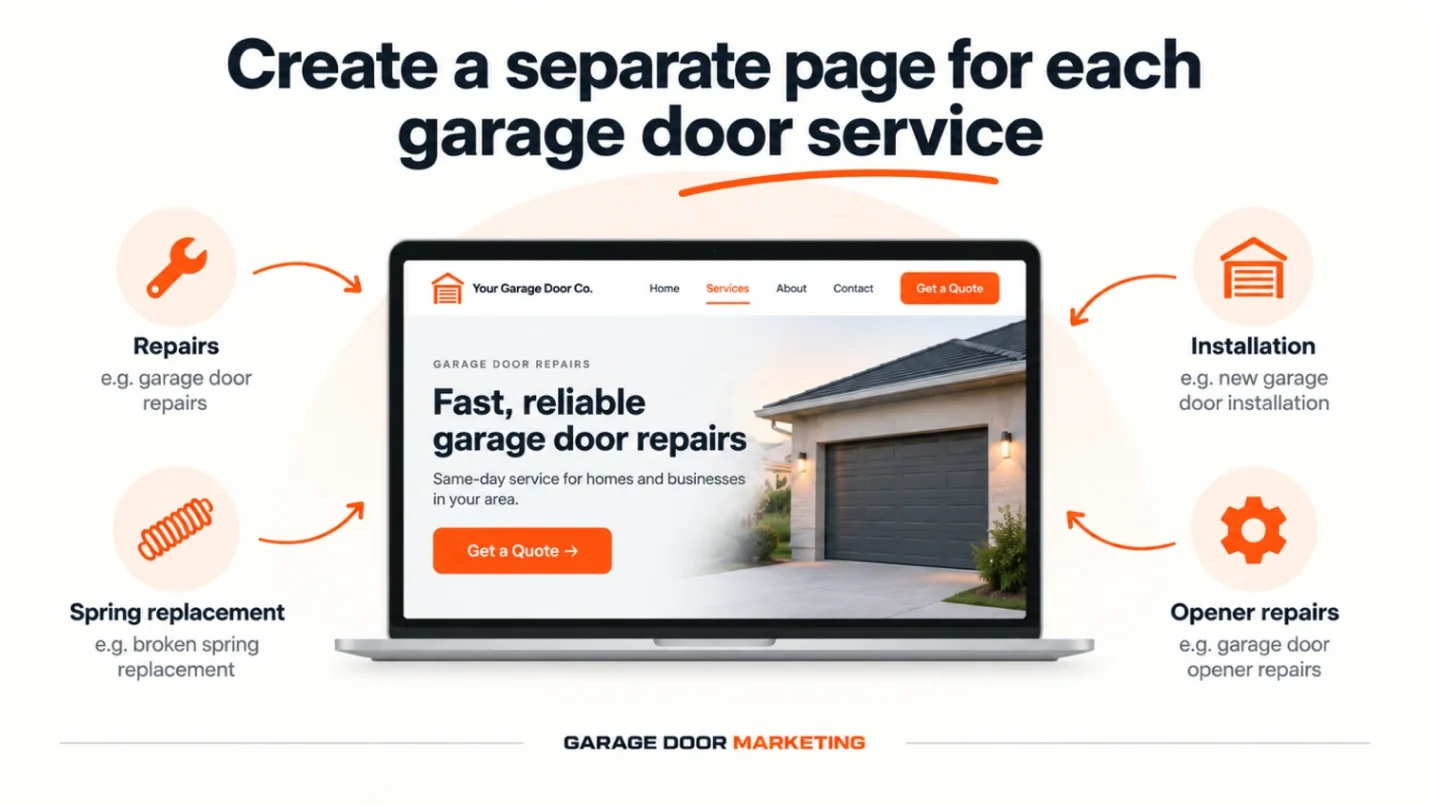
On each page, explain the problem you fix, what the service involves, and how customers can book an appointment. Add a visible call button or quote form so visitors know what to do next.
For example, if someone clicks an ad for spring repair, send them to your spring repair page rather than your homepage. They'll find relevant information without searching through your other services.
If you serve multiple towns or suburbs, mention your service areas on your website. You can also create dedicated location pages with useful local details, such as completed jobs in the area, services available there, and the towns or cities you cover.
This helps homeowners understand whether you serve their area and which services they can book. Keep each location page specific to that area. Avoid copying the same content across different cities.
Need help improving your website and marketing? Contact the Garage Marketing team to discuss your options.
3. Improve your website's loading speed on mobile
Homeowners often use their phones to find a garage door repair company. If your website loads slowly or makes it hard to find your phone number, they may leave before contacting you.
Speed matters. In 2016, Google reported that 53% of mobile visitors left sites that took longer than three seconds to load. This is historical data, not a current benchmark for garage door websites, but it shows why loading speed matters. Read Google's research on mobile site speed.
Start by testing your main landing pages on a mobile device. Check how quickly each page loads and whether the phone number, call button and quote form are easy to find and use.
Follow these steps to find and fix issues:
- Check loading speed: Run your main landing pages through Google PageSpeed Insights to identify performance issues.
- Find what's slowing pages down: Look for large images, unnecessary scripts and other elements that delay loading.
- Make the fixes: Compress images, remove unnecessary pop-ups and ask your developer to address technical issues affecting page speed.
- Test the pages again: Rerun the speed test and check the changes on your phone. Make sure the pages load properly and the main actions are easy to complete.
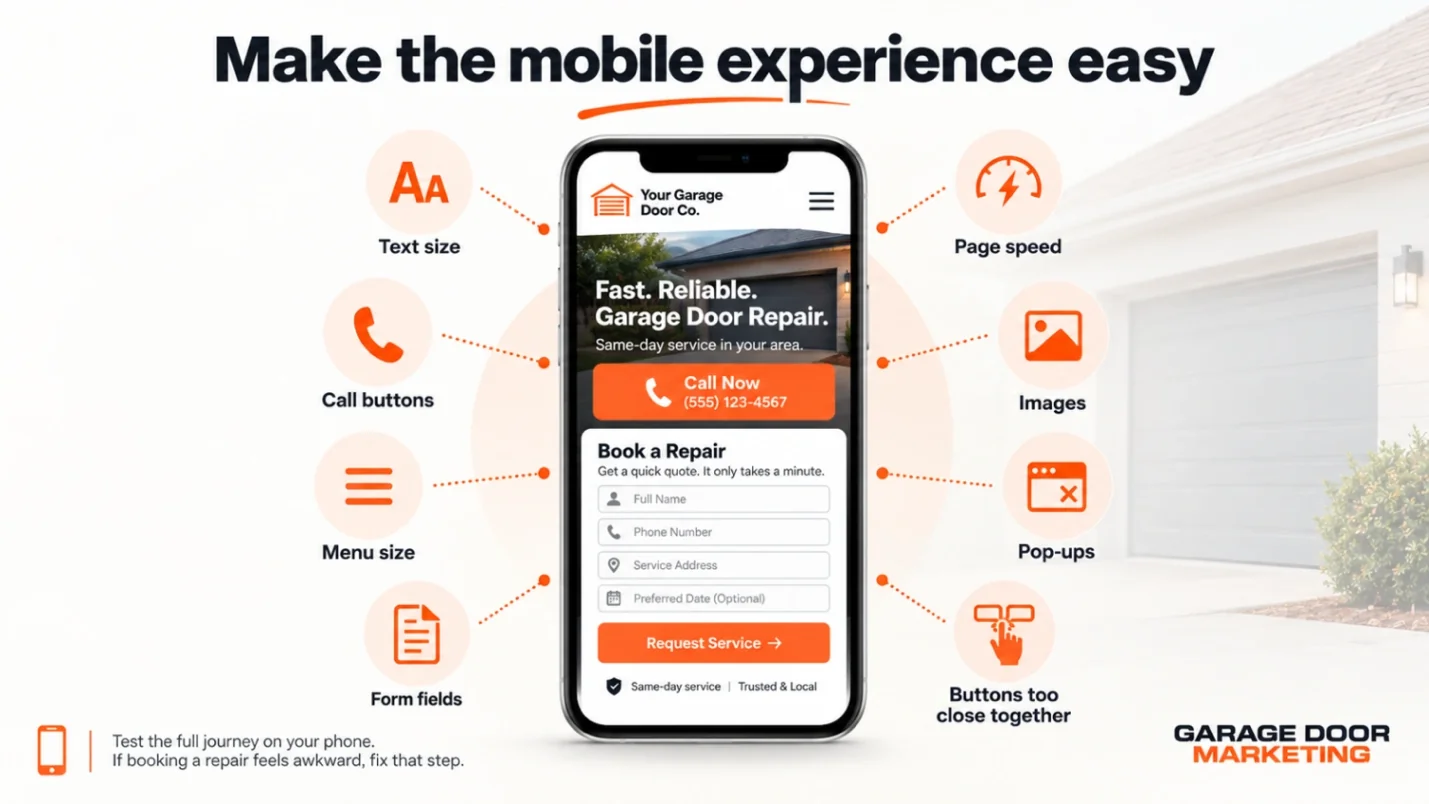
Also, check these elements on mobile:
- Text size: Make sure the text is readable without zooming in.
- Call buttons: Keep them easy to find and tap.
- Menus: Make navigation simple, with enough space between links.
- Form fields: Keep forms short and easy to complete on a phone.
- Images and pop-ups: Make sure images load properly and pop-ups don't cover important information.
- Buttons and links: Leave enough space between clickable elements to prevent accidental taps.
People shouldn't need to zoom in, tap tiny links or wait several seconds for large images to load.
Finally, test your website yourself. Call your business using the website's phone number and submit a quote request from your phone. Fix any issues you find and test again. A fast, easy-to-use website makes it simpler for homeowners to contact you about garage door repairs and replacements.
4. Show proof that homeowners can trust
Almost every garage door company claims to offer reliable service and experienced technicians. Show homeowners what backs up those claims.
Add real photos, customer reviews, and details about your work. These give potential customers a better idea of what to expect before they call.
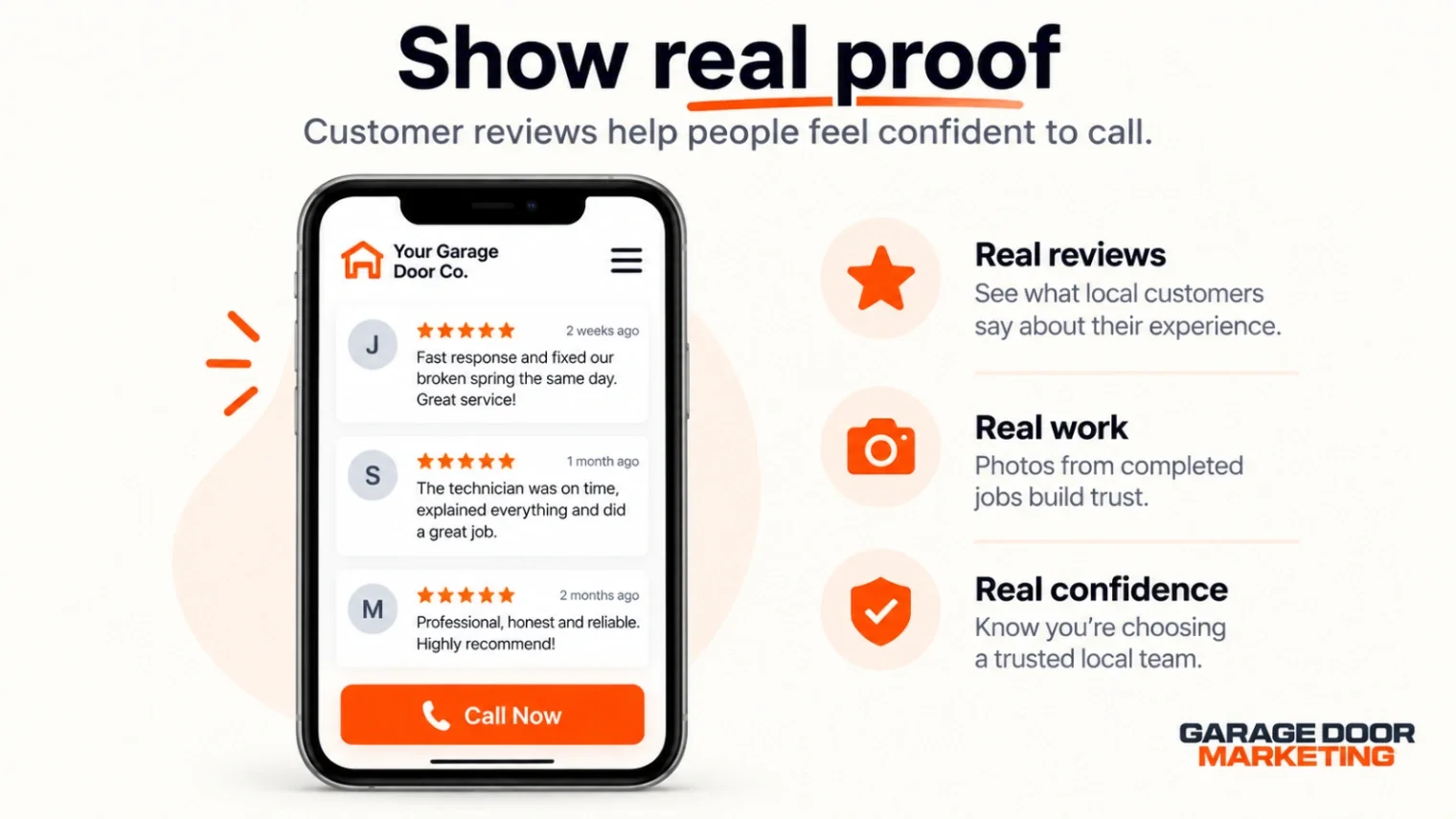
Useful proof can include:
- Recent customer reviews
- Photos from completed jobs
- Photos of technicians and service vehicles
- Business registration details where appropriate
- Relevant licenses or certifications
- Warranty information
- Brands you regularly work with
- Years of experience
Reviews matter, too. BrightLocal's 2025 Local Consumer Review Survey, based on a US consumer survey, found that customer reviews and photos or videos can help consumers feel more confident about choosing a local business.
Ask customers to leave honest reviews on your Google Business Profile after the service. Request reviews consistently rather than only from customers you expect to leave positive feedback.
Respond professionally to both positive and negative feedback. When possible, use specific reviews that describe the work, such as a spring replacement or opener repair.
Place your strongest reviews and job photos near your Call Now button or quote form. This lets homeowners see proof of your work when they're deciding whether to contact you.
5. Keep your quote form short
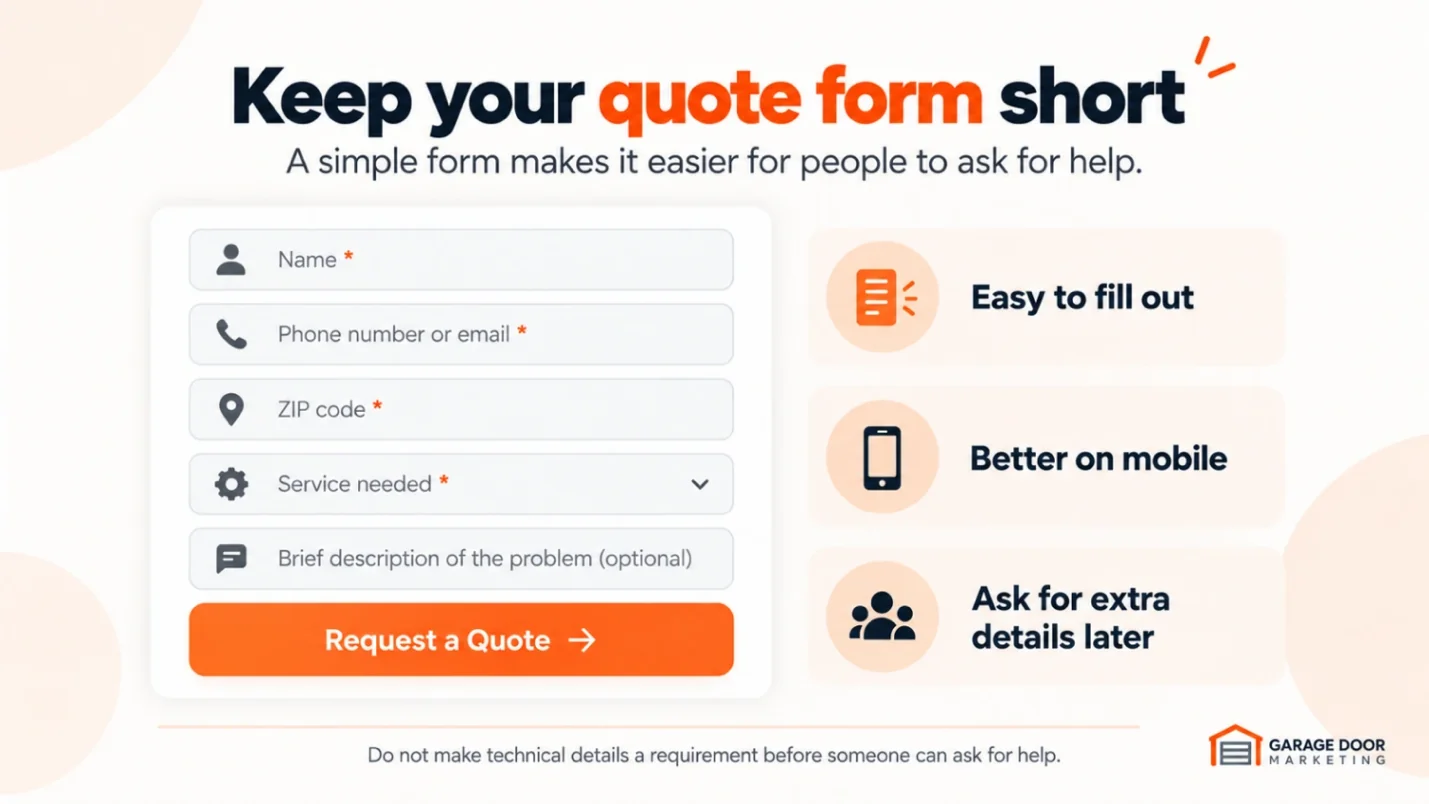
A long quote form can discourage homeowners from contacting your garage door business. Ask for the basics first. You can collect more details when you follow up.
For an initial inquiry, include:
- Name (required)
- Phone number or email (require at least one, unless your follow-up process needs both)
- ZIP code (required to check whether the homeowner is within your service area)
- Service needed (required)
- Brief description of the problem (optional)
Homeowners may not know which spring broke or what type of opener they have. Let them explain the problem in their own words. For example, they might write, “My garage door opens halfway and then stops.”
Make the form easy to complete on a phone, too. DreamHost's guide to lead generation for service businesses recommends asking for enough information to start a useful conversation without making the form too long.
Before publishing, test the quote form on a phone. Check these:
- Every field is easy to read and fill out.
- The form submits without errors.
- A confirmation message appears.
- The inquiry reaches the right inbox.
Finally, make sure someone follows up promptly. A simple form only helps your business when customer inquiries reach your team and receive a response.
6. Write for the problem the customer needs to solve
Homeowners search for answers when something goes wrong with their garage door. Your website should address those problems instead of repeating the same keywords.
Create content around common customer questions, such as:
- Why won't my garage door close?
- Why does my garage door reverse before closing?
- Can I use my garage door if a spring breaks?
- Why is my garage door making a grinding noise?
- Should I repair or replace my garage door?
- Can I replace just one garage door panel?
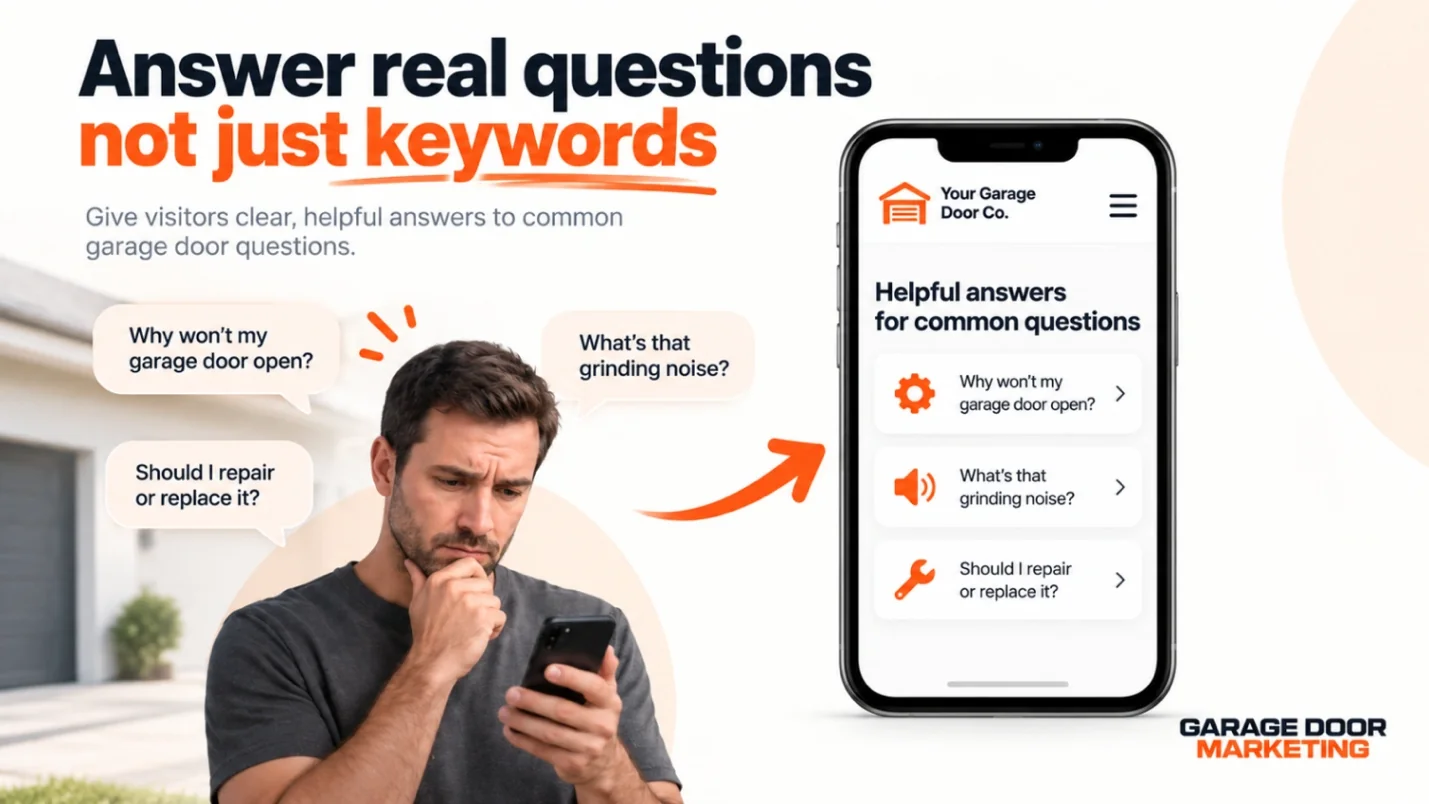
Keep your answers accurate and practical. Explain common causes, what homeowners can safely check, and when they should call a technician.
Google's guidance on helpful, people-first content recommends creating content that serves readers' needs rather than focusing only on search rankings.
Use phrases like “garage door won't close” when they fit the topic. Focus on giving homeowners useful answers, not repeating keywords to improve rankings.
Finally, add a relevant call to action to each page. For example, a page about a "garage door that won't close" can invite readers to book a repair while a page about "replacing a garage door panel" can offer a quote for the replacement.
7. Track calls and inquiries, not just traffic
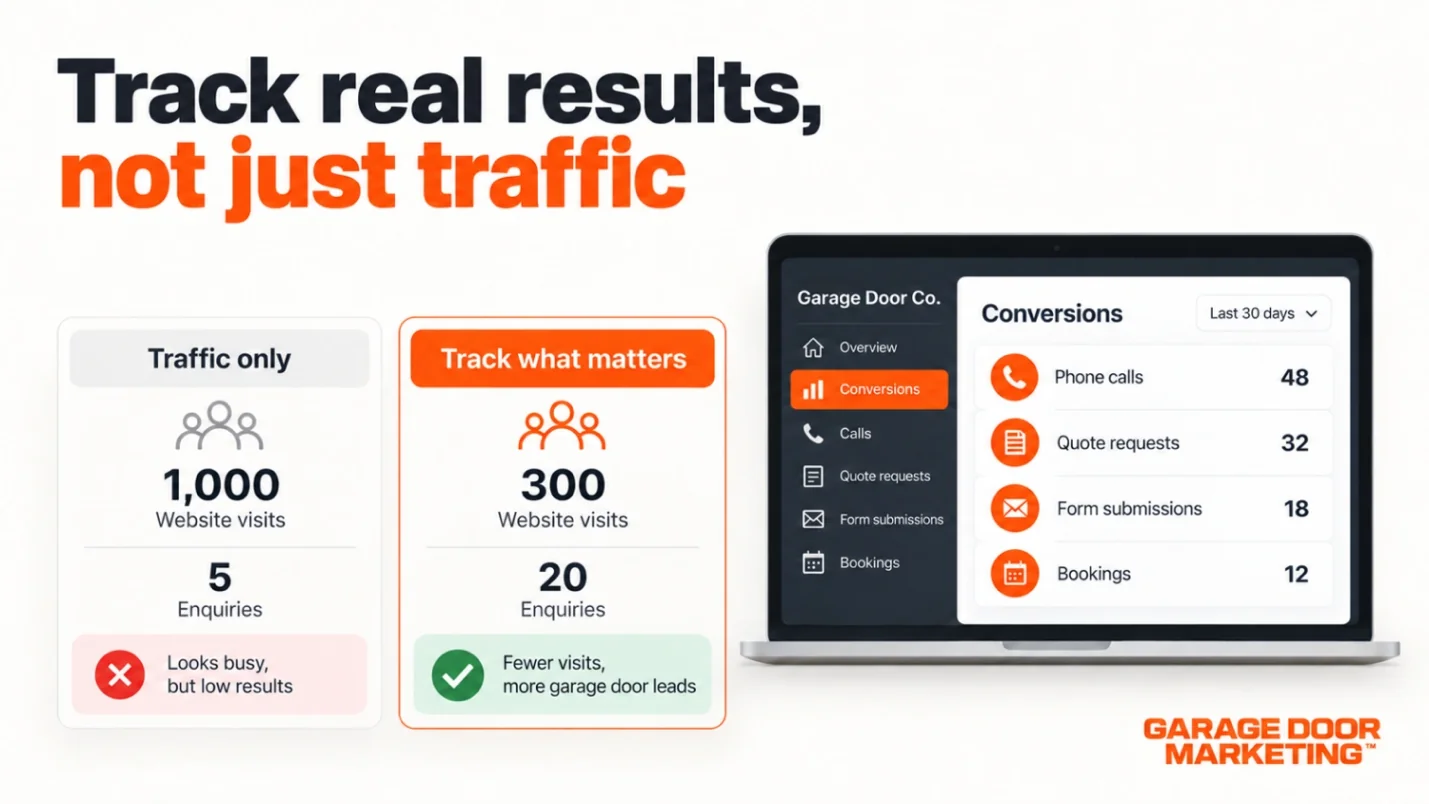
Your website traffic may be growing, but which pages get homeowners to call or request a quote? Tracking this helps you understand what's working and where you may be losing potential jobs.
Start by tracking these actions separately:
- Phone calls: Track calls through call tracking software, including calls from your website and Google Business Profile where possible.
- Phone-number clicks: Use Google Tag Manager and GA4 to record when someone clicks your phone number. A click doesn't necessarily mean a call took place.
- Quote requests: Track form submissions and booking requests as separate conversion actions in GA4.
- Qualified leads: Record which inquiries match your services, location and job requirements in your CRM.
- Booked and completed jobs: Update each lead's status in your CRM so you can see which inquiries turn into paying customers.
Connect your tracking data with your CRM where possible. This helps you avoid counting one customer twice when they contact you through multiple channels.
Also, record the traffic source and landing page for each lead. This helps you understand which marketing channels and pages bring in inquiries, qualified leads and booked jobs.
For example, imagine two pages have the following results:
- Page A: 1,000 visits and 5 inquiries, giving it a 0.5% inquiry rate.
- Page B: 300 visits and 20 inquiries, giving it a 6.7% inquiry rate.
These figures are hypothetical. Page B generates a higher share of inquiries despite receiving less traffic. However, that doesn't automatically mean it brings in better leads or more profitable jobs. Check how many inquiries qualify, how many jobs get booked, and how much revenue those jobs generate.
Review these numbers regularly. Focus on the pages and marketing channels that bring in qualified garage door leads and help you book profitable jobs.
Before You Spend More on Traffic, Fix Your Website
When calls slow down, you might think you need more website traffic. But first, check whether your current visitors can find your services and contact you.
Small changes can make a difference. Focus on the pages that already get traffic and remove barriers that stop people from reaching out.
Then track your calls, form submissions, and booked jobs month over month. This will help you see whether your website improvements are bringing in more garage door leads.
Want to find out where your website is losing potential customers? Book a free 30-minute call with the Garage Marketing team to discuss your website and lead generation.
