

Key takeaways
- Focus your garage door repair ads on searches tied to services you provide.
- Review search terms, negative keywords, locations, and lead quality before raising your budget.
- Track calls and booked jobs so Google Ads can optimize toward leads that matter.
- Keep repair, installation, and other services separate when the search intent and job values differ.
- Judge performance by cost per qualified lead and booked job, rather than clicks alone.
Garage door repair ads can reach homeowners who are actively looking for help. Someone searching for a broken spring, stuck door, or garage door repair near them usually needs help soon.
The problem is that Google Ads can also spend money fast. Loose keywords can attract the wrong searches. Poor location settings and weak tracking can waste even more of your budget.
If your garage door ads are getting traffic but the phone isn’t ringing enough, don’t assume you need to spend more. Start by finding where the wasted budget comes from.
Here are 9 ways to find and cut wasted spend.
1. Target keywords with strong repair intent
Keyword choice is one of the biggest factors in how much wasted spend you get. Someone searching "garage door repair near me" may be ready to hire.
Meanwhile, someone searching “garage door ideas,” “garage door parts,” or “how to fix garage door spring” may only be researching or planning a DIY repair.
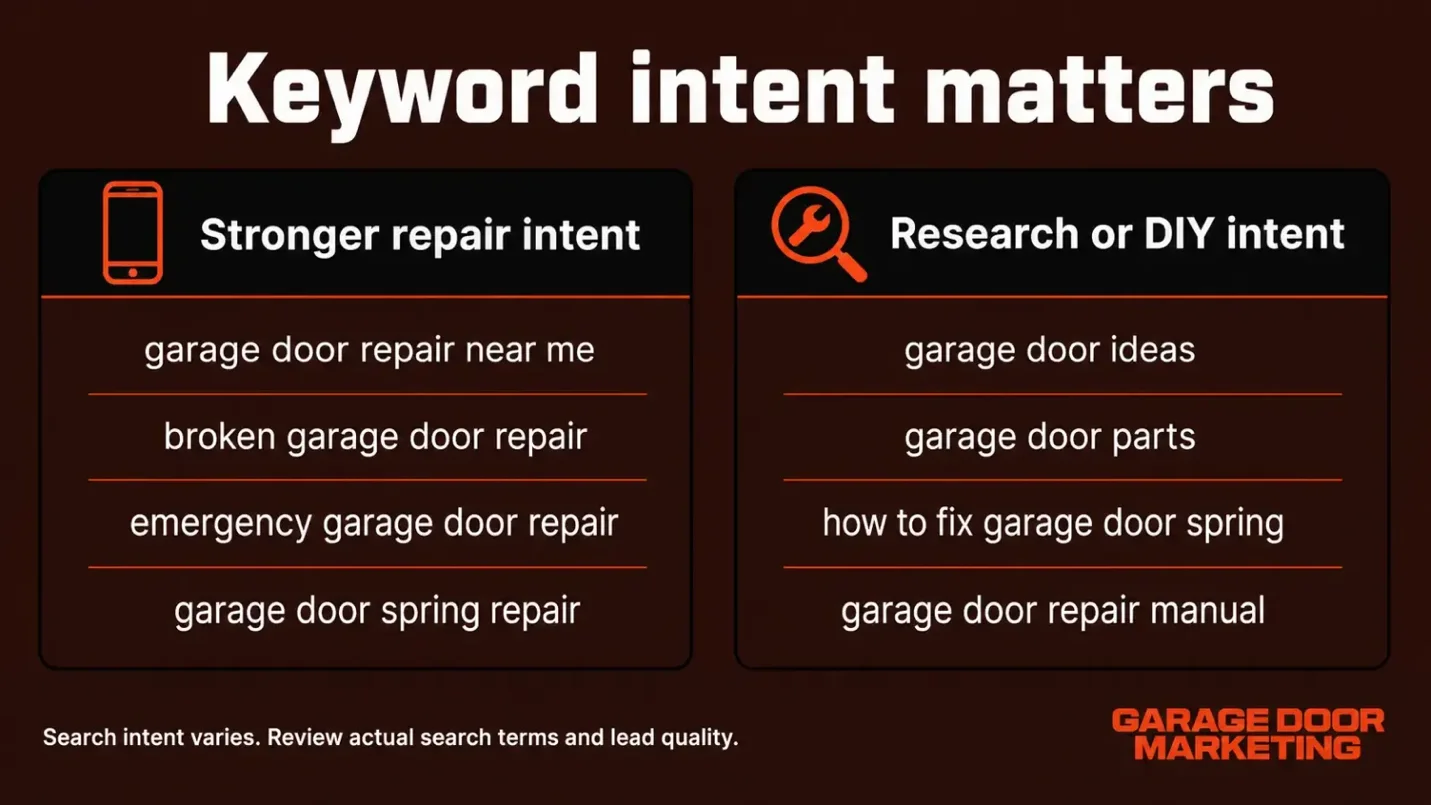
Google offers broad, phrase, and exact keyword match types. Exact match provides the narrowest reach of the 3, but it can still match searches with the same meaning or intent. Phrase and broad match can reach a wider range of related searches. Google explains the differences in its Google Ads keyword matching guide.
You don’t need hundreds of keywords to start. Build a focused list around the repairs you provide, such as:
- “garage door repair near me”
- “broken garage door spring repair”
- “garage door cable repair”
- “garage door opener repair”
- “emergency garage door repair”
Start with phrase and exact match keywords so you can review the searches they attract. Test broad match later if you have reliable conversion tracking, enough qualified-lead data, and the budget to manage a wider range of searches.
2. Build a negative keyword list early
Even good keywords can trigger bad searches.
Ads for repair terms can still appear for the wrong searches. These may include DIY guides, replacement parts, jobs, training, manuals, or free advice. Each irrelevant click uses budget that could have gone toward a repair lead.
Check your search terms report at least once a week when a campaign is new. The report shows the searches that triggered your ads, so you can find irrelevant terms and add them as negative keywords. Google explains how to use this data in its Google Ads search terms report guide.
Common negative keyword themes may include:
- jobs
- salary
- training
- course
- DIY
- manual
- parts
- wholesale
- used
- free
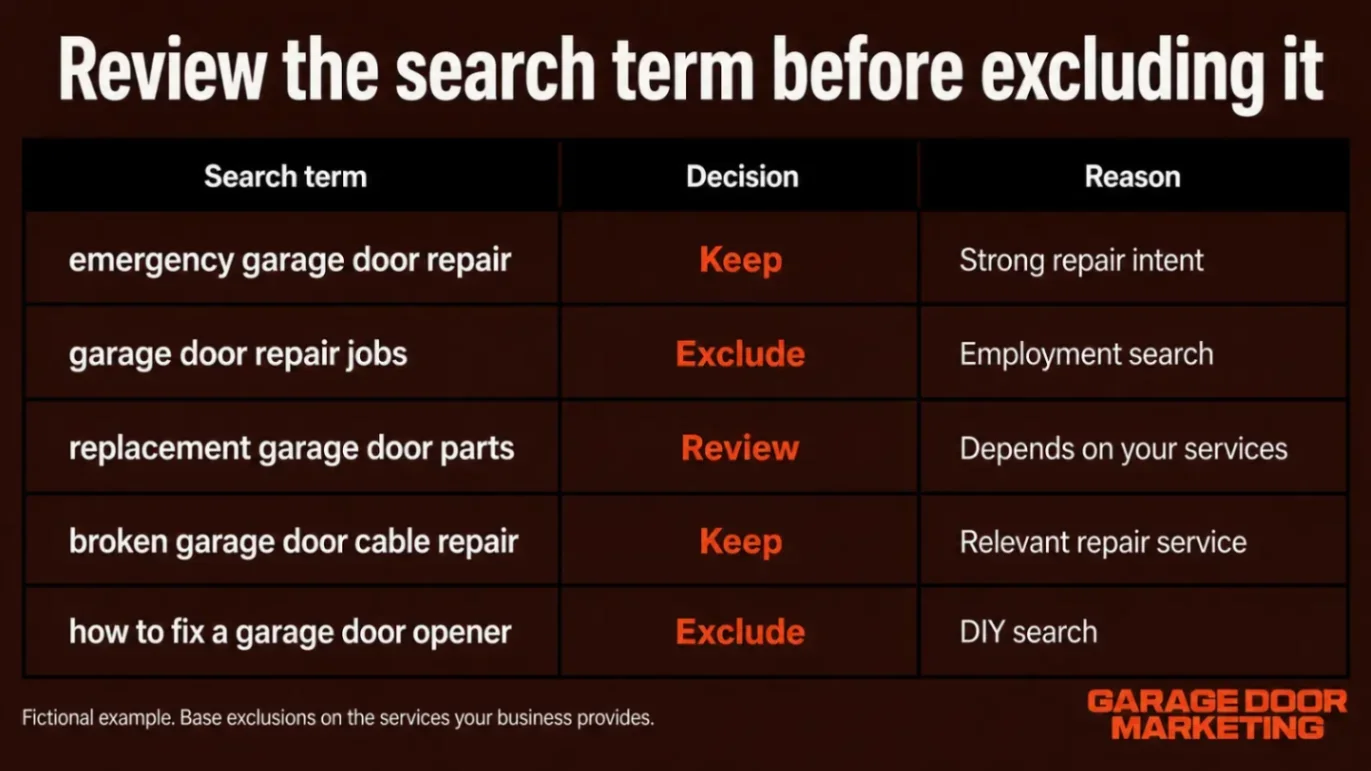
Don’t copy a huge negative keyword list from another account and call it done. A garage door company that sells parts, for example, shouldn’t block every parts-related search.
Review the actual searches your ads trigger, then exclude the ones that don’t match your services. Choose the negative match type carefully too. A broad negative such as “parts” may block several searches containing that word, while an exact negative only blocks that specific search. Check the likely effect before adding account-wide negatives.
3. Keep your service area under control
Local targeting sounds simple, but it’s an easy place to waste money.
You may serve a 20-mile area around your shop while Google Ads reaches people outside it. Google’s default setting can include people who have shown interest in your targeted location. They don’t have to be physically there.
For a local garage door service, consider whether “Presence” targeting makes more sense. This option targets people Google believes are in your selected locations or visit them regularly. Google explains both options in its guide to advanced Google Ads location targeting.
Then, review the locations where users were physically located, not only the areas you selected in the campaign settings. Compare spend, qualified calls, booked jobs, and travel time by ZIP code or city.
For example, one ZIP code may produce 12 qualified repair leads from $700 in spend, while another uses the same amount and produces only 2 unqualified inquiries. You could exclude the second area, reduce its coverage, or move it into a separate campaign if its job values justify continued testing.
Location optimization isn’t only about excluding faraway areas. It can also help you put more budget behind neighborhoods where your garage door leads tend to turn into good jobs.
4. Separate repair traffic from installation traffic
Someone with a garage door stuck halfway open has a different need from someone researching a new garage door.
Treating both searches the same can hurt your ads, landing page relevance, and conversion rates. Separate services when their search intent, landing pages, or job values differ.
A starting structure could be:
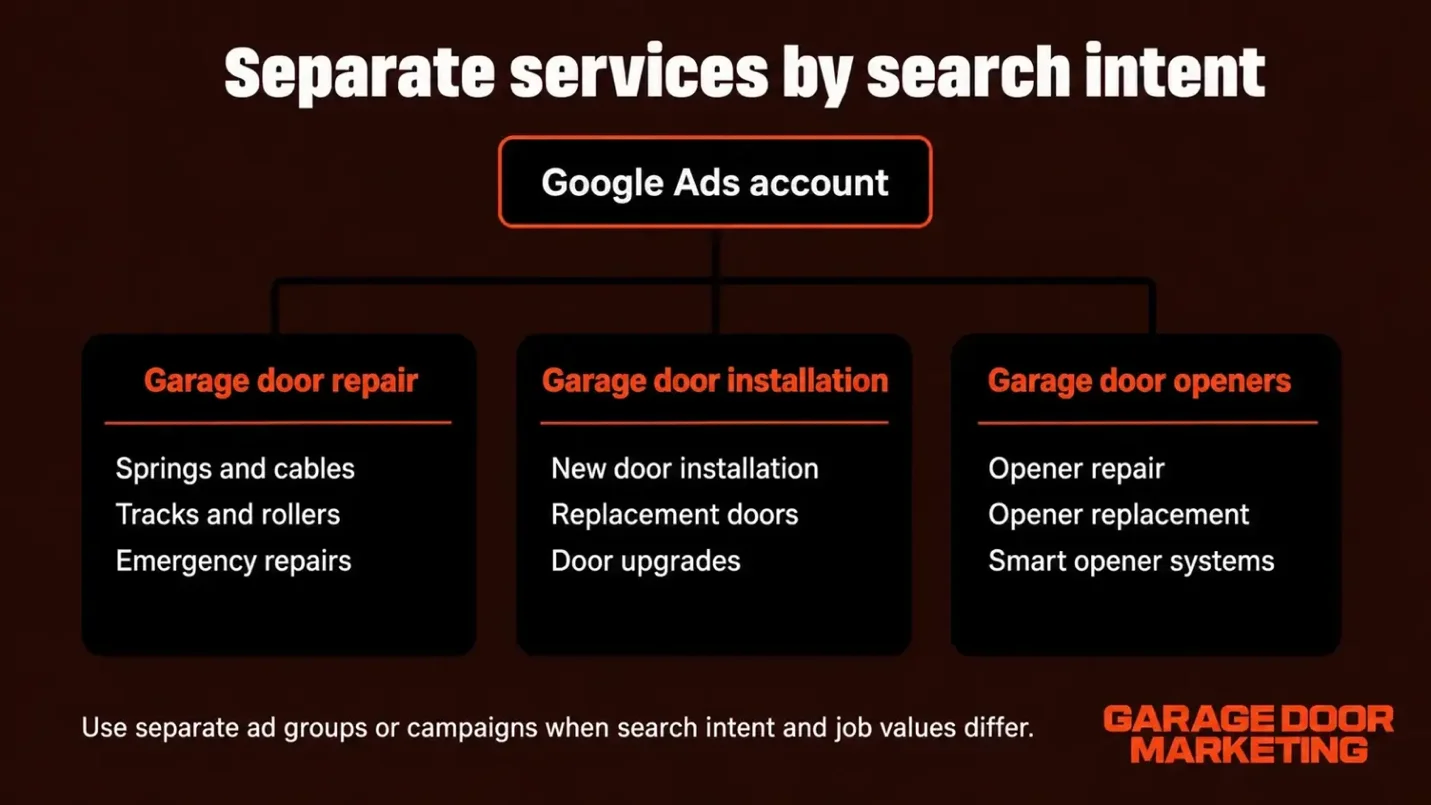
Each ad group should contain closely related keywords, ads written for that service, and a relevant landing page. If the budget is limited, start with the repair services that generate the most profitable jobs instead of launching every campaign at once.
This structure also helps you control bidding based on job value. A lead tied to a $200 repair job and a lead tied to a $4,000 installation job shouldn’t be treated as if they’re worth the same amount.
Google Ads can capture people who are already searching, but it doesn’t have to be your only channel. Our guide to the best ways to advertise a garage door business compares paid search with local listings, referrals, vehicle graphics, and other methods.
5. Make the ad match the search
Garage door companies sometimes try to fit every service into one ad.
That usually creates vague copy.
If someone searches for emergency garage door repair, your ad should talk about repair. If they search for garage door installation, the ad should focus on installation.
For example, a generic headline such as “Local Garage Door Company” doesn’t confirm that the company handles the searcher’s problem.
For a search such as “broken garage door spring repair,” stronger headlines could include:
- Garage Door Spring Repair
- Broken Spring Repair Near You
- 24/7 Garage Door Repair
Only include “same-day” or “emergency” wording if the business can consistently provide that service.
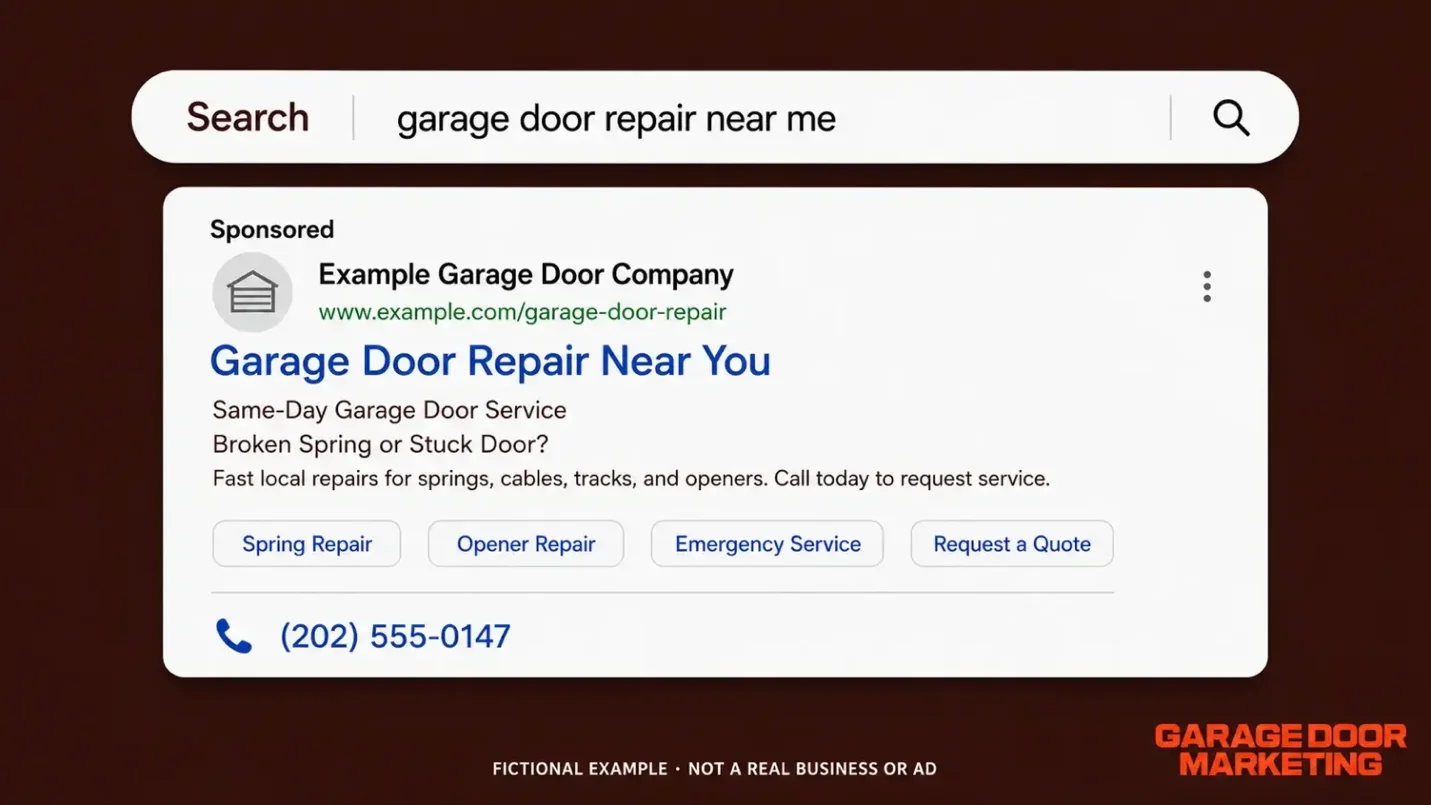
Use the description to explain why someone should choose you. Mention your service times, warranties, years in business, or service areas.
Use relevant ad assets too. Call buttons, sitelinks, and location details give searchers more ways to respond. You can review the available options in Google’s guide to Google Ads asset types.
Avoid claims you can’t prove. If you don’t offer 24/7 repair, don’t advertise 24/7 repair just because competitors do.
6. Send clicks to the right landing page
Someone searching for “broken garage door spring repair” should reach a page focused on that service. If the page covers too many unrelated services, they may leave before finding the information they need.
A dedicated repair landing page should quickly cover:
- The repair services you provide
- Your service area
- A phone number people can tap
- A short quote or booking form
- Reviews or other proof
- Business hours or emergency availability
- What happens after someone contacts you
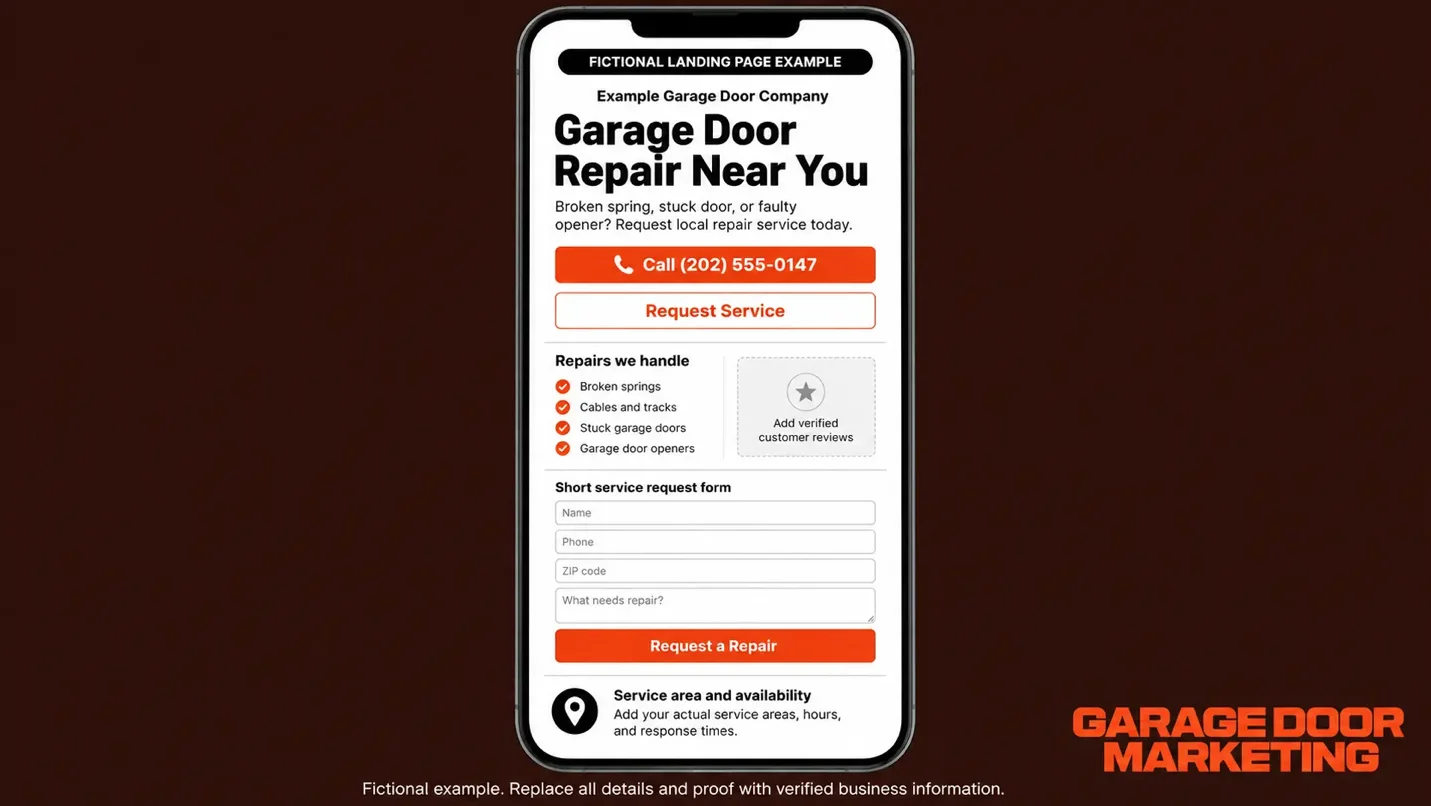
Keep the main action easy to find on mobile. A homeowner with a stuck garage door wants help fast. Don’t make them search through 6 menu items.
You can also create separate landing pages when services have very different intent. Garage door repair, commercial service, and garage door installation are good candidates.
If the search terms are relevant but few visitors call or submit the form, inspect the landing page before increasing the budget. Check the page on mobile, test every call button and form, review its loading speed, and confirm that the service and location mentioned in the ad appear near the top of the page.
Also, compare conversion rates by device and landing page. If mobile traffic performs poorly while desktop traffic converts, the problem may be the mobile experience rather than the keywords.
7. Track calls that become actual leads
A campaign can report plenty of conversions and still bring in poor leads.
Phone tracking matters for garage door marketing. Many homeowners call instead of filling out a form. Google Ads can track calls from ads, calls from a website after an ad click, and call conversions uploaded from another system. Its guide to setting up phone call conversions explains these methods.
Don’t stop at “a call happened.”
Track whether the call was:
- A genuine repair inquiry
- Inside your service area
- For a service you provide
- Qualified enough for a quote
- Booked
- Completed
Store this information in a call-tracking platform such as WhatConverts, or in your CRM, and connect it to the original campaign where possible. You can then import qualified leads, booked jobs, or completed sales into Google Ads instead of asking automated bidding to optimize toward every call equally. This shows which campaigns are producing revenue, not only phone calls.
Campaign A may generate 30 calls at $50 each, while Campaign B generates 20 calls at $65 each. Campaign A looks better until you find out Campaign B booked twice as many jobs.
That’s why cost per lead should never be the only number you use.
The video below explains how WhatConverts can be used to track leads and sales.
8. Don’t let bidding outrun your data
Automated bidding can work well, but it needs useful conversion data.
Google’s Smart Bidding uses conversion tracking data to optimize bids in each ad auction. That makes the quality of your tracking especially important. Google explains the process in its Google Ads Smart Bidding guide.
If every 10-second phone call counts as a conversion, Google may learn to find more short phone calls. That doesn’t guarantee more booked repair jobs.
Fix tracking before making aggressive bidding changes.
Also avoid changing budgets, bidding, keywords, ads, and locations at the same time. You’ll have a harder time knowing what caused the result.
Make one meaningful change, record the date, gather enough data, and review what happened. Compare the result with the same period from the previous year where possible. Repair demand may change with weather, holidays, and seasonal conditions.
If you need help auditing and improving your marketing, check out our garage door repair PPC management services.
9. Judge spend by booked jobs, not traffic
Clicks are easy to measure. Revenue matters more.
Your reporting should connect ad spend to qualified leads, booked jobs, and sales whenever possible.
For example:
- Ad spend: $4,000
- Repair leads: 50
- Qualified leads: 35
- Completed jobs: 20
- Average completed job value: $600
- Revenue: $12,000
In this example, the campaign produced a 3:1 revenue-to-ad-spend ratio.
That isn’t the same as profit or ROI. To judge profitability, subtract labor, materials, overhead, ad spend, and other costs from the revenue generated.
You can then compare services separately. Repairs may produce more leads. New garage door installations may produce fewer leads but a higher average sale.
This also helps when deciding how Google Ads, LSAs, SEO, and other marketing for garage door companies should share your budget.
For more options beyond paid search, check these garage door marketing ideas for generating more leads and sales.
The cheapest lead source isn’t automatically the best one. Put more weight on the source producing profitable jobs.
Start with the biggest source of waste
You don’t need to rebuild every garage door ad campaign at once.
Start with the areas most likely to cost you money. Review search terms, negative keywords, location settings, and conversion tracking. Check the landing page people reach after clicking too.
Then, look at campaign structure, ads, bidding, and lead quality. Focus your ads on people searching for the repair services you provide, then measure how many of those clicks become profitable jobs.
Once that process works consistently, you can decide whether to increase your budget. You won’t have to spend more and hope the extra traffic produces jobs.
For help finding wasted spend and improving lead quality, contact us at Garage Marketing for a free campaign review.
